2026IndependentSlopSoup TV on YouTube
A television network that runs itself
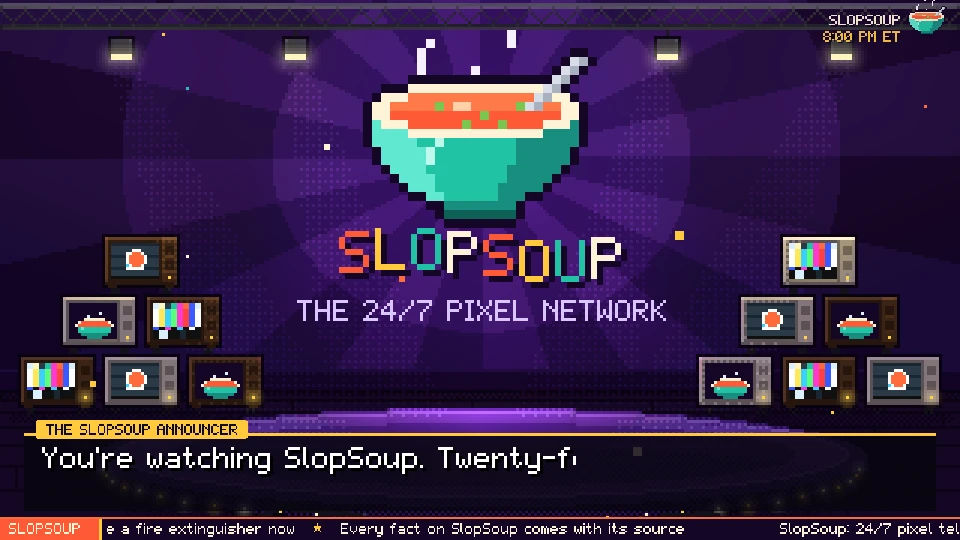
SlopSoup TV is a 24-hour pixel-art channel run end to end by software: writing, casting, voices, music, scheduling and the live broadcast. It is my test bed for long-running AI systems that have to stay up, stay on budget and stay in tune.

- Outcome
- Live on YouTube around the clock, on a fixed published schedule, with a daily spend cap and a free mode that runs at $0
- Role
- Sole engineer, writer of the show bibles, and the person on call
- Stack
- Python · Hugging Face Inference Providers · llama.cpp · Breeze-TTS · Kokoro · ACE-Step · Fibo · Chromium · x264 · HLS · RTMPS · ZeroGPU
- Links
- Visit SlopSoup TV
- on air, on a fixed published grid
- 24/7
- on air, on a fixed published grid
- shows with their own bibles and critics
- 20
- shows with their own bibles and critics
- test files, including a simulated 24-hour playout
- 111
- test files, including a simulated 24-hour playout
- real-time encode on a 16-vCPU Space
- 1.0×
- real-time encode on a 16-vCPU Space
Why build it
Most generative AI demos make one thing once. A broadcast has to make something new every hour, forever, without anyone checking it first. That makes it the hardest test of a content pipeline I could think of, and the most fun to watch fail and fix.
How it works
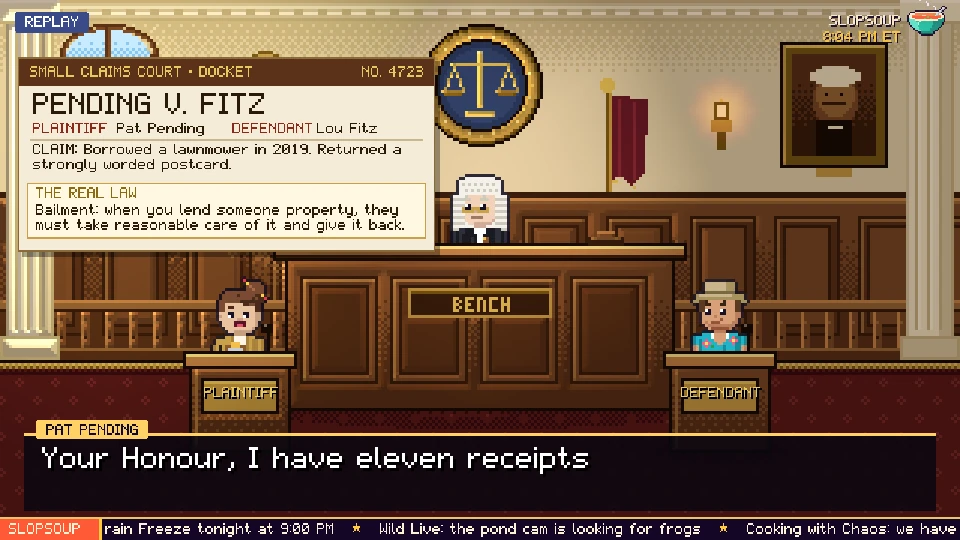
The schedule is a published grid: twenty shows, each with fixed weekly slots, so a viewer can find Small Claims Court at 13:15 every day. Every hour opens with the News Desk, and Launch Watch breaks in before real rocket launches.
 On air
SlopSoup TV
- Heat this hour
- 0 / 10
- Fresh airtime budget
- 1,300 min a day
- Speech farm
- 0.75× real time beside the encoder
Each episode moves through premise, outline, script and shot list, and every stage has its own critic that can send it back. A continuity log and season arcs keep stories coherent across weeks. A novelty ledger built on embeddings and Bloom filters stops the writers repeating themselves, and a heat dial sets how edgy the writing may get by hour.
Voices come from a farm of Breeze-TTS servers sized to the machine. Music comes from ACE-Step, art from Fibo on ZeroGPU, all directed through structured prompts. The browser renders the show while the server directs it, about 40 seconds of timed cues ahead. Xvfb, Chromium and x264 make an HLS stream that relays to YouTube over RTMPS.
Reliability
The parts that make it run unattended are ordinary engineering. Writer models route through tiers of providers with automatic failover and a daily dollar cap. Pinned providers answer in 3 to 8 seconds against about 30 with automatic routing. If YouTube drops the connection, the pusher redials within seconds. Playout snapshots every 10 seconds so a restart resumes where it left off. A voice governor pauses speech synthesis whenever the encoder falls behind real time. Deterministic checks and a standards judge model review every script, and a control room shows the queue, the audit log and kill switches. Free mode runs the whole network on local models at no cost.
What it taught me
The same lessons apply to an enterprise content pipeline: critics at every stage, budgets enforced in code, graceful degradation, and a human control room with an off switch.